
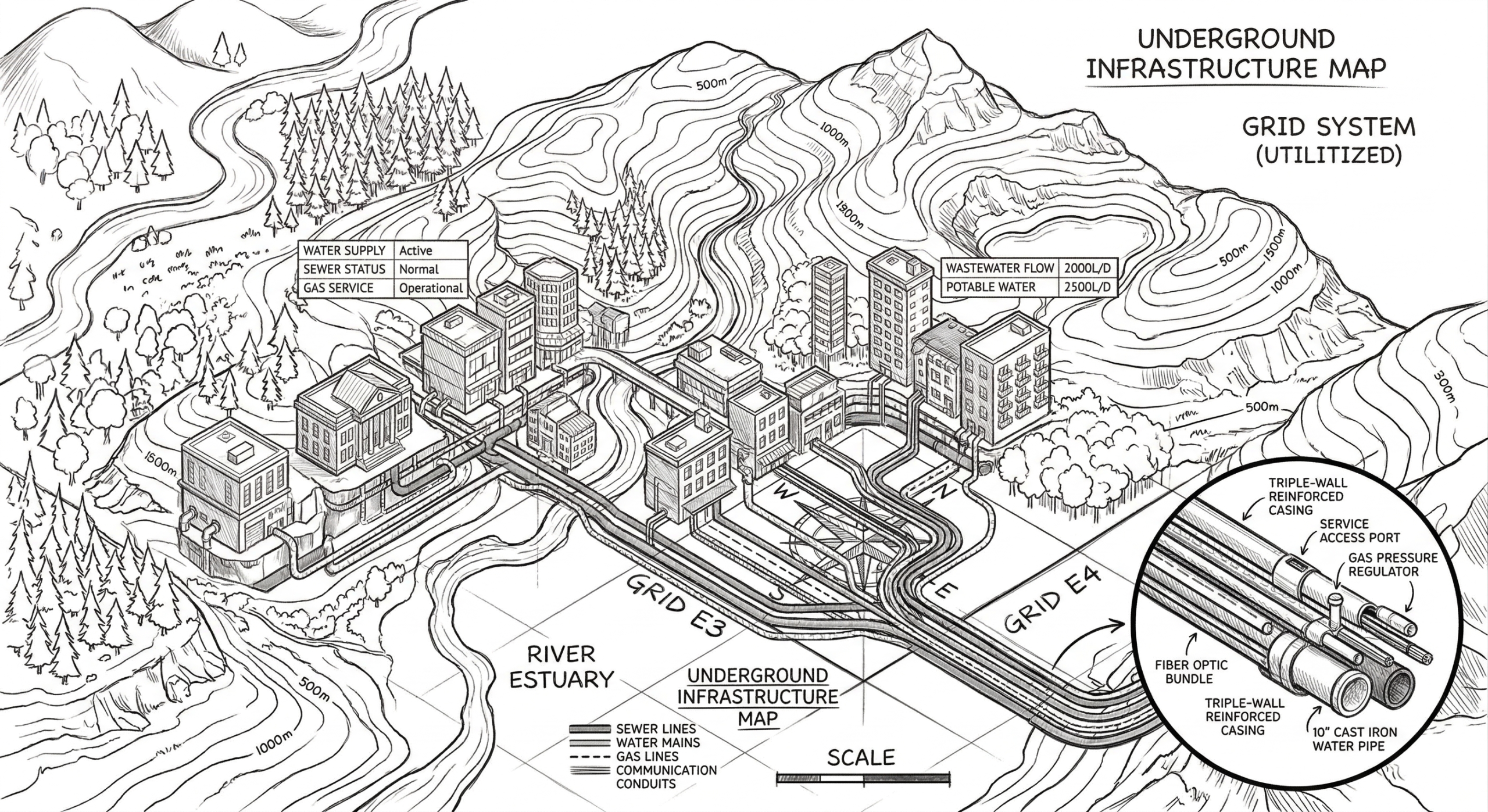
You’ve mapped the domains. You’ve debated topology. You’ve drawn the roads and zoned the neighbourhoods. The town plan is taking shape.
But there’s something beneath the streets that determines whether the town truly works — or just looks like it does.
The grid.
The invisible infrastructure that carries everything — power, water, gas — quietly, beneath the surface. When it’s designed well, nobody thinks about it. When it’s not, everything that depends on it starts to fail.
Metadata is your organisation’s grid.
Walk beneath any large organisation and you’ll find the same sprawl.
- Glossaries maintained by governance.
- Data dictionaries owned by engineering.
- Business models in an enterprise architecture repository.
- A CMDB tracking infrastructure.
- Catalogues aggregating assets.
- RBAC policies controlling access.
- Standards documents that nobody quite follows consistently.
- And maybe a few different metadata tools that were meant to rein them all in. (why didn’t they?)

Two types of lineage — and why both matter
Lineage is among the most valuable metadata an organisation can maintain. Modern tools focus on data lineage— and many forget the other critical type of lineage:
- Data lineage tracks the technical journey — where data originates, how it moves, what transforms it along the way.
- Semantic lineage maps the meaning — how a business concept like “revenue” is defined in the glossary, represented in the model, and surfaced in the report.

Together they answer the two questions every data consumer eventually asks: where did this come from? And what does it actually mean?
Metadata is everyone’s business — and that’s good. And that’s also why this is hard.
Answering these simple questions requires the piecing together of many different pieces of a puzzle — each piece serving a different purpose, a different audience, a different need. The pieces are scattered and out of sync. And maintaining any single piece is always someone else’s job. Putting it together is often an afterthought.
Anyone familiar with MDM will recognise this pattern. The sprawl. The duplication. The same concept, different owners, different versions, depending on where you look. Metadata is no different.
Design the grid right — and the whole town thrives
A good measure of metadata is whether people actually maintain it and use it.
Metadata consolidation and synchronisation are critical for achieving a consistent, unified view of data assets, enabling reliable lineage, governance, and context across the data ecosystem:
- Eliminate Silos: Aggregates metadata from diverse tools (e.g. dbt, Unity Catalog, PowerBI, MLflow) into a central catalogue, ensuring all stakeholders access the same contextual information.
- Improve Trust and Traceability: Enables end-to-end lineage and visibility, helping users understand where data comes from, how it is transformed, and how it is used across platforms.
- Enable Automation and Governance: Supports data quality, access control, and policy enforcement through unified metadata APIs and standardized governance models.
The goal isn’t a single perfect repository — it’s a living connected ecosystem. Frictionless to contribute to. Automated as much as possible. Fresh, complete, and always within reach of the people who need it. Design it for all participants — or it won’t work.
The diagram below illustrates just one example of how metadata objects and elements that are created and managed across diverse tools and contexts—each serving a distinct role in the broader data and technology ecosystem.

The takeaway
Metadata belongs at the town planning table — alongside topology, governance, and platform architecture.
Make it flow, keep it fresh and in sync; reduce friction. Plan accordingly.
Here are some principles for good metadata to reflect on to help you get started:
| Principle | Description |
|---|---|
| Accessible | Easy to find, search, use and maintain — by business, technical and governance stakeholders. |
| Dynamic | Automate collection and updates to keep metadata fresh and reduce manual work. |
| Contextual | Serve the right metadata, in the right place, in the right format — bridging business, technical, governance and architecture perspectives. |
| Integrated | Exists in an ecosystem across tools to support diverse workflows. |
| Consistent | Common standards, terms and structures — current and in-sync across the estate. |
| Secure | Protected as sensitive — metadata can reveal as much as the data itself. |
| Accountable | Clearly defined roles for ownership and stewardship across every domain. |
| Agnostic | Portable and open — avoid vendor lock-in, ensure flexibility and interoperability. |
Explore the enterprise metadata architecture →
— Benson