
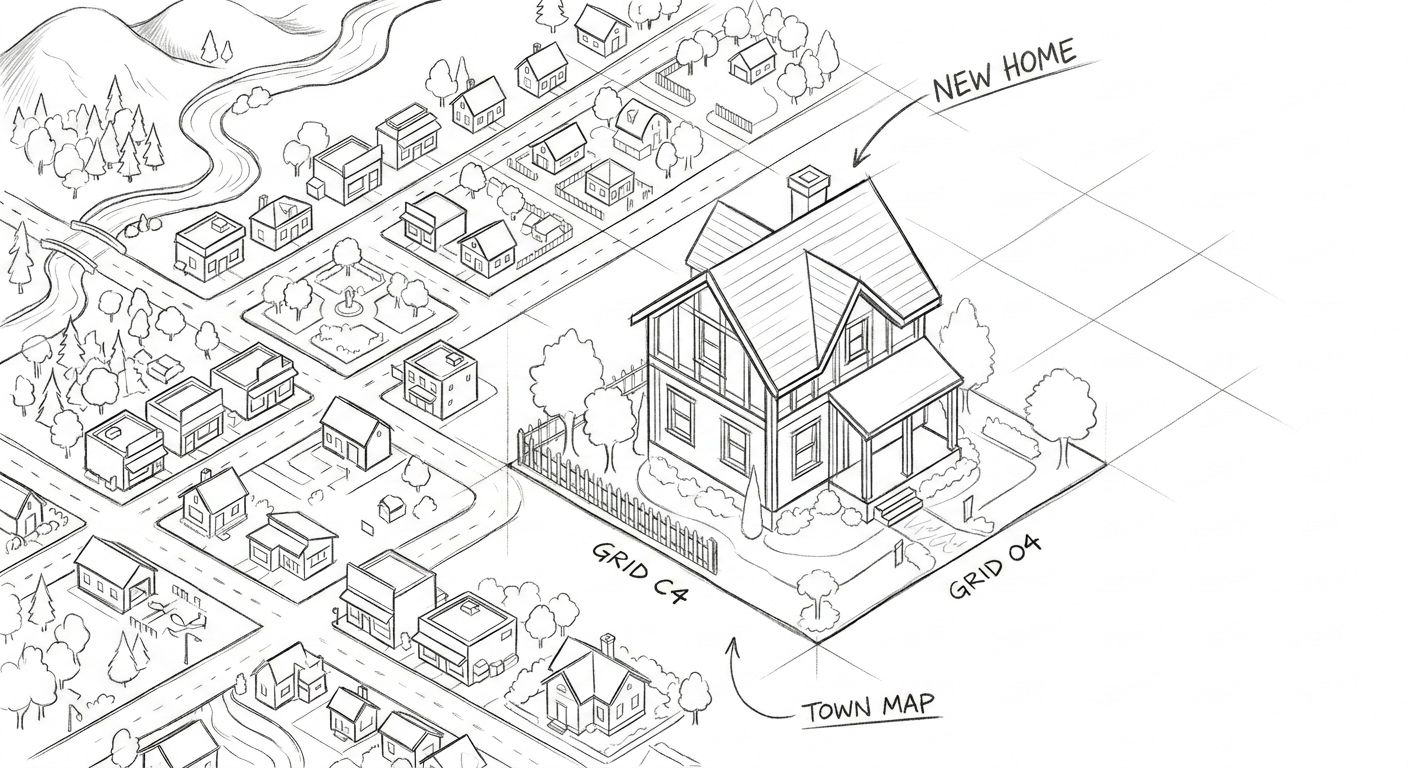
Most data platform initiatives start with a use case. A business unit with a problem, a scope that feels manageable. That’s a house. It’s easy to get lost in it — the footings, the rooms, the plumbing.
But what about the road that connects it? The utilities beneath it? The zoning that determines what gets built next door? What services should be shared across the neighbourhood? These aren’t decisions for the homeowner — they’re decisions for the town. And they need to be made before the foundations are poured.
Data platforms and data domains work the same way.
A home needs a plan. For it to thrive, it needs a town plan.
Every town is made up of neighbourhoods — each with its own character, its own residents, its own local services. Some services belong locally — the corner shop, the GP. Others belong centrally — the hospital, the water grid. And some things must be agreed across all neighbourhoods before anyone breaks ground.
These neighbourhoods are data domains. And that arrangement — how they are structured, how they interact, who owns what, who serves whom — is the topology.
Topology design is just as much about architecture as it is about power and accountability — who owns what, who serves whom, who carries the cost, who can move fast and who has to wait.
Get it wrong and you produce bottlenecks, fragmentation, and accountability gaps. Get it right and the whole town thrives.
Reference topologies exist because these patterns tend to recur. At the extremes:
- Fully centralised — consistency is high, so is the bottleneck. Domains are consumers with little accountability. The centre enforces governance, but can also be the constraint.
- Fully federated — agility is high, so is duplication. Cross-domain analytics interations are P2P. Governance becomes distributed and risks of inconsistency high.
Most large organisations land somewhere between — centralising what benefits from consistency, federating what benefits from autonomy.
The hybrid federated mesh pattern reflects this balance; consolidation upstream, federation downstream.
In town planning terms:
The water grid is centralised. The corner café is not. Nobody expects the municipality to run every coffee machine, and nobody expects every neighbourhood to dig its own reservoir.
In data platform terms:

Engineering — ingestion, quality, initial transformation — sits centrally. So do the shared services that every domain depends on: governance, security, metadata, billing. These are the roads and utilities of the town plan. Built once, maintained centrally, available to all.
Analytics, local modelling, and domain-specific products sit with the teams closest to the problem. Domains access shared, trusted data from across the organisation while retaining the autonomy to build for their own needs.
The result is a platform designed around a simple principle:
Discipline at the core, flexibility at the edge.
Explore the hybrid federated mesh topology →
– Benson